
Residence card for students in Warsaw
We help students obtain a residence card based on studies in Warsaw: we verify the legal basis, prepare documents from the university or school and assist with the electronic application through MOS 2.0.
Fill out the form and receive a free consultation
Cooperation process
01
Initial free consultation
1. During the consultation, we will verify your basis: a university, post-secondary school, course or another educational programme; 2. We will assess your documents, the duration of studies, tuition fees, insurance and the financial resources required for the residence-card application.

02
Preparing a step-by-step action plan
1. We will sign an assistance agreement; 2. We will prepare a personalised document checklist for your study situation; 3. We will explain the application through MOS 2.0 and the further handling of your case step by step.
03
Preparing all required documents
1. We will complete all required forms; 2. We will help collect documents from the university or school, proof of tuition payment, insurance and financial documents; 3. When a document exists only as a paper original, we will prepare it for electronic submission in your case.


04
Full assistance until you receive the residence card
1. On the day of your appointment at the office, a dedicated specialist will accompany you as your authorised representative (pełnomocnik); 2. We monitor the case status every day, inform you about changes and respond to official requests.
05
Handling the case through to completion
1. We monitor the final stage after a positive decision is issued; 2. We provide an attractive discount on further services offered by our company.

- Payment in 2 instalments
- Legal consultation
- Preparation of a personalised document checklist
- Document review
- Completion of the electronic application in MOS 2.0
- Electronic submission of documents
- Payment in 3 instalments
- Legal consultation
- Preparation of a personalised document checklist
- Document review
- Completion of the electronic application in MOS 2.0
- Electronic submission of documents
- Document collection
- Collecting documents from the university or school
- Assistance during the in-person appointment
- Full monitoring of your case
- Electronic submission of additional documents in your case
- Free appeal in case of refusal
- Payment in 3 instalments
- Legal consultation
- Preparation of a personalised document checklist
- Document review
- Completion of the electronic application in MOS 2.0
- Electronic submission of documents
- Document collection
- Collecting documents from the university or school
- Assistance during the in-person appointment
- Full monitoring of your case
- Electronic submission of additional documents in your case
- Free appeal in case of refusal
- Preparation of a formal reminder (ponaglenie)
- Preparation of a complaint to the administrative court
- Assistance on the day you collect your residence card
- Help setting up a Trusted Profile (Profil Zaufany)
- Setting up an e-Delivery inbox (e-Doręczenia)
The running of deadlines in residence-card cases is suspended until 4 March 2027
This follows from the Act on Assistance to Ukrainian Citizens. Articles 100c and 100d suspended certain administrative deadlines, so the voivode may process a residence-card case for longer than the standard period.
The processing speed can still be influenced. We first file a formal reminder (ponaglenie) with the higher authority and, if there is no response, a complaint about inactivity or excessive delay with the voivodeship administrative court. These steps often prompt the authority to address the case, may accelerate the decision and may lead the court to award a monetary sum. We prepare the submissions and help accelerate the case.
When APPROXIMATELY can a decision be expected?
Enter the filing date or planned filing date and select the type of case. We will show the difference between the statutory deadline and approximate processing time in Warsaw.
You may enter a future date when you are only planning to file the application.
Your estimated timeline
Comparison of the statutory deadline and the approximate waiting time in Warsaw.
Filing date
The date from which the estimate is calculated.
Statutory deadline
—
Practice in Warsaw
Approximate processing time in practice.
This is an estimate, not an official forecast
The actual processing time depends on the voivodeship, the legal basis, official requests, the completeness of the documents and the office's workload.
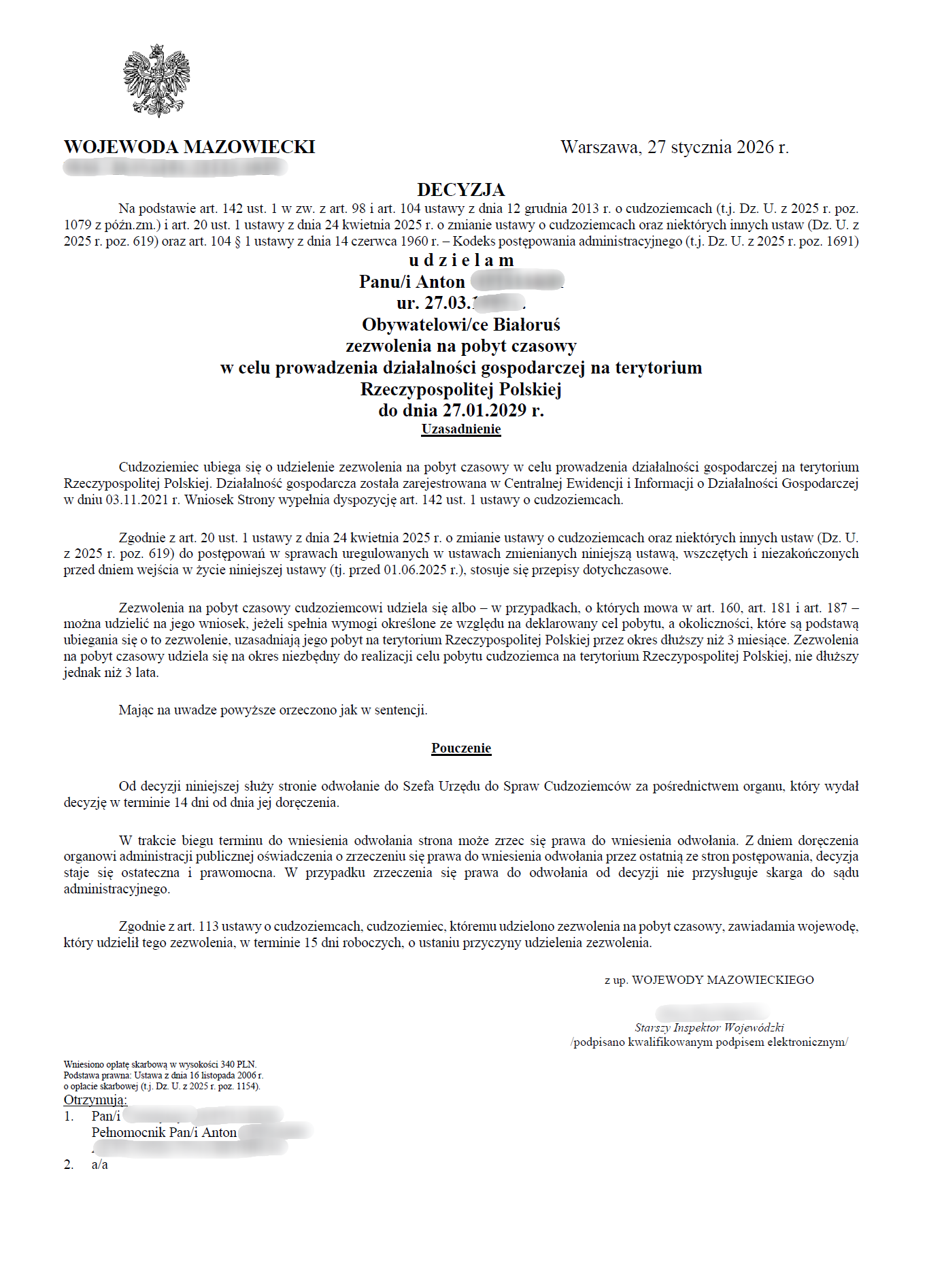
How to start working with us?
We assess every case individually and select an approach suited to the circumstances.
-
01
01
Submit a request
Complete the form and we will contact you shortly.
-
02
02
Receive a consultation
The initial telephone consultation is free.
-
03
03
Arrange an office appointment
At the office, we will review your situation in detail and propose an appropriate solution.
-
04
04
Submitting the documents
The application is submitted online through MOS 2.0. We provide full assistance throughout the process.
-
05
05
Receive the result
We cannot guarantee the outcome, but we will take every possible step to achieve a positive result.
SKILLDOCS Telegram bot SKILLDOCS
Every client receives free access to our bot, which simplifies the residence-legalisation process in Poland.
Automatic case monitoring in INPOL
The bot monitors changes in the case and informs you before the official correspondence arrives.
Case status and stages in one chat
The client can see the current stage of the case and the actions being performed.
Appointment and deadline reminders
Notifications help you remember appointments at the office and important document deadlines.
Active tasks in your case
The bot shows what is currently being handled and which steps are still pending.
Assign a task to a team member through Telegram
The client can quickly assign a task to our team without additional calls or waiting.
cases connected to the bot
The bot checks case statuses every day and immediately informs clients about new decisions.
Current INPOL case status
Name: Ruslan
Case number: WSC-II-P..2026
Case status: W toku - wezwanie o braki merytoryczne
Active case: Przygotowany projekt decyzji pozytywnej
Latest event:
Decision deadline: .2026
16:10SKILLDOCS combines professional assistance
with automated case monitoring after the documents are submitted.
Required documents
Documents for a student residence-card application through MOS 2.0 are prepared electronically. The final list depends on the university or school, the form of study, tuition fees, insurance and the method used to prove sufficient financial resources.
passport
required by MOS
paid
insurance
continuation of studies
resources
Poland
in Polish
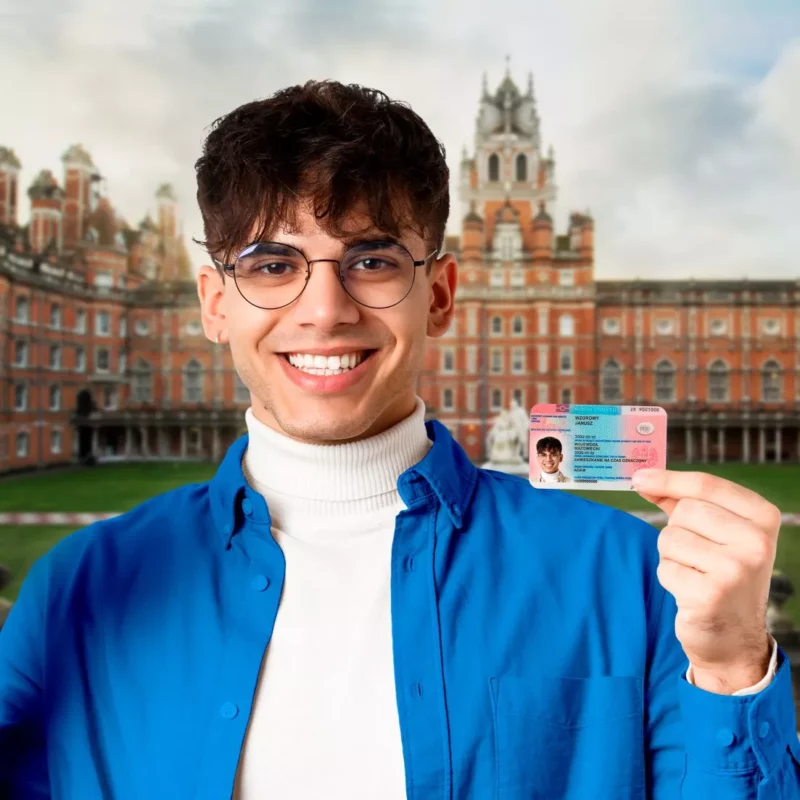
RESIDENCE CARD FOR STUDENTS IN WARSAW
A residence card for students is intended for foreign nationals studying at a Polish university, post-secondary school or under another educational programme who want to stay legally in Poland for the duration of their studies.
The application requires proof of more than enrolment alone. The applicant must also document financial resources, insurance, accommodation, tuition payments and the required documents from the university or school.
Since 27 April 2026, the standard temporary-residence application has been submitted electronically through MOS 2.0. The documents must therefore be prepared for electronic submission and the further handling of the case.
We verify the legal basis, help collect documents from the educational institution, prepare the application and assist with the case until a decision is issued.
WHAT A STUDENT RESIDENCE CARD IN POLAND PROVIDES
— Legal residence in Poland for the validity period of the permit;
— The ability to continue studying at a Polish educational institution;
— The ability to leave Poland and return with a valid residence card and passport;
— Short trips within the Schengen Area under the 90/180-day rule;
— The ability to combine studies with work when permitted by your status and individual circumstances;
— A basis for further legalisation of residence in Poland;
— The possibility of switching to another type of permit when the basis of residence changes.
DOCUMENTS FOR A STUDENT RESIDENCE CARD THROUGH MOS 2.0
1. A completed electronic application in MOS 2.0.
2. A digital photograph for the MOS 2.0 application.
3. Scans or photographs of all pages of a valid passport.
4. Proof of payment of the stamp duty for processing the application.
5. A document from the university or school confirming admission, continuation of studies or student status.
6. A document stating the tuition fees for the academic year or semester.
7. Proof of tuition payment when the programme is paid.
8. Documents confirming health insurance in Poland.
9. Documents confirming sufficient financial resources for living expenses and studies.
10. Proof of an address in Poland when required in the case.
11. An electronic attachment from the university or school when required for the relevant basis in MOS.
12. Polish translations when documents were issued in another language and require a sworn translation.
13. When an authorised representative files the application — a power of attorney and proof of the PLN 17 fee.
14. Electronically certified scans of paper originals when documents existing only in paper form must be added to the case.
After the launch of MOS 2.0, paper supplements are not accepted at the customer-service desk. When the office requests further documents, they must be submitted electronically. When a document exists only as a paper original, an electronically certified true copy must be prepared in advance.
WHICH BASIS IS SUITABLE FOR A STUDENT
The correct basis depends on the type of education: university studies, post-secondary school, a course, full-time or part-time studies, continuation of studies or the start of a new programme.
Before applying, it is necessary to confirm whether the programme can support a study-based residence application, which documents the university or school must issue and whether the financial evidence is sufficient.
When the study basis is weak or does not meet the requirements, we identify other legalisation options that may be available.
Full-time university studies
Suitable for bachelor's, master's, long-cycle master's and doctoral programmes. You must show that studying is the main purpose of your stay in Poland.
Preparatory course
It may provide a basis when the course prepares the applicant to begin studies at a Polish university. Documents must confirm the dates, purpose, fees, insurance, address and financial resources.
Post-secondary school
A study-based application may be filed. The school must confirm the duration and form of classes, as well as the tuition fees or exemption from them. The permit may be issued for a maximum of 12 months.
Courses and other educational programmes
An application is possible when the programme lasts more than 3 months and is properly documented. The documents must cover the dates, number of hours, attendance, fees, insurance, address and financial resources. The permit may be issued for up to 12 months.
Part-time studies
A study-based application may also be filed for part-time studies. The office checks the course of studies, tuition fees, insurance, address and financial resources. The permit may be issued for up to 12 months.
Subsequent application based on studies
This is a new assessment of the legal basis, not an automatic extension of the previous card. The first permit for a first-year student is issued for a maximum of 15 months. A subsequent permit may cover the study period plus 3 months, up to a maximum of 3 years.
RESIDENCE CARD BASED ON STUDIES IN POLAND
A residence card based on studies is a temporary residence permit for a foreign national studying in Poland who can prove the purpose of residence with documents from the university or school.
Admission or continuation-of-study documents are not sufficient on their own. Insurance, financial resources, accommodation and a correctly prepared application in MOS 2.0 are also required.
For university studies, the institution may complete and sign the relevant attachment to the application online in MOS.
How does the university or school affect the residence-card application?
Before applying for a residence card based on studies, both the documents and the educational institution itself must be checked. The requirements differ for universities, post-secondary schools, preparatory courses and other educational programmes.
The office assesses whether the programme can support a residence permit, whether the institution is authorised to admit foreign nationals, whether the documents were issued correctly and whether the information matches the MOS 2.0 application.
Before filing, we verify the legal basis, the institution's documents, the duration of the programme and how the complete application will be assessed by the office.
Living expenses
More than 1,010 zł for each month of residence when the student lives alone. For a family, the calculation is based on 823 zł per person per month.
Accommodation costs
Monthly rent and utility costs are added to the living-expense requirement, including electricity, gas, water and waste collection. The total is divided by the number of residents.
Return travel
200 zł when arriving from a country bordering Poland, 500 zł from an EU country without a common border with Poland and 2,500 zł from a non-EU country.
Tuition fees
For a paid programme, proof of payment or funds covering the unpaid tuition for the academic year are required.
For the first year, the calculation covers 15 months: 15 × 1,010 zł is already 15,150 zł, excluding accommodation and return travel. For a family, 823 zł per person is used instead of 1,010 zł.
Key considerations when applying for a student residence card in Warsaw
A student residence-card application in Warsaw requires careful preparation because the office checks the genuine course of studies, tuition payments, financial resources, insurance and accommodation, as well as the fact of enrolment itself.
After the transition to MOS 2.0, documents must be prepared electronically in advance, and the information in the application must match the documents from the educational institution and the payment evidence.
We help students prepare their applications in Warsaw: we review the documents, explain what must be obtained from the institution, prepare the application and assist with the case through MOS 2.0.
Can you work with a residence card issued on the basis of studies?
A full-time student at a Polish university may work without a separate work permit when staying on a national visa issued for studies or on a residence card issued under Article 144(1) of the Act on Foreigners. UdSC also describes the situation while awaiting a decision, provided that the study-based application was filed on time and any formal deficiencies were remedied within the prescribed deadline.
Post-secondary schools, courses, part-time studies and a change of legal basis require an individual assessment.
From 1 July 2026, not every foreign national with student status may work without a permit. The educational institution also matters.
You can check whether you may work without a separate permit on this page — a document containing the list of eligible institutions will be downloaded.
When a student cannot switch to a work-based residence permit
Can a student register a sole proprietorship in Poland?
A student may register a sole proprietorship (JDG), but the right depends on the residence document rather than student status alone. A residence card issued for full-time university studies under Article 144 of the Act on Foreigners allows the holder to conduct business on the same terms as Polish citizens. This follows directly from Article 4(2) of the Act of 6 March 2018 on the rules governing participation of foreign entrepreneurs in economic activity in Poland (Journal of Laws 2025, item 89).
A student visa and a residence card issued for another form of education, including part-time or postgraduate studies or a post-secondary school, do not automatically provide this right. Another legal basis may then be required, such as a Polish Card (Karta Polaka), UKR status for a Ukrainian citizen or marriage to a Polish citizen.
Registration in CEIDG is free, and the foreign national states the relevant residence document. A JDG does not legalise residence by itself. Studies remain the basis of the current card, while switching to a business-based permit requires a separate procedure and compliance with the income requirements.
Taxes and ZUS for students under 26
A student under 26 working under a contract of mandate (umowa zlecenia) costs the contracting party less. When the contract is concluded with a student who has not turned 26, ZUS contributions are not paid. The student must retain student status and the contract must be of the correct type.
The youth tax relief (ulga dla młodych) applies to PIT. Income of up to PLN 85,528 in a tax year may be exempt when the person is under 26 and the income qualifies for the relief. The calculation changes for an employment contract, a JDG, loss of student status or after the person turns 26.
What to do after graduation
After graduating from a Polish university, you may apply for temporary residence as a graduate. This permit is intended for seeking employment or preparing to start a business. Under Article 190 of the Act on Foreigners, it is issued once for 9 months, directly after the completion of university studies or scientific research.
Proof of Polish-language proficiency
From 1 July 2025, a certificate of completion of a post-secondary school no longer proves Polish-language proficiency either in proceedings for recognition as a Polish citizen or in proceedings for an EU long-term resident permit. For citizenship, this follows from Article 30(2a) of the Polish Citizenship Act; for EU long-term residence, from Article 211(3) of the Act on Foreigners. The amendments were introduced by the Act of 4 April 2025 (Journal of Laws 2025, item 622).
Two transitional rules were provided. Proceedings initiated before 1 July 2025 and not completed by a decision continue under the previous rules, so a post-secondary-school certificate may still be accepted. A certificate issued by 30 June 2025 could also be used in proceedings initiated between 1 July 2025 and 30 June 2026. After 30 June 2026, the certificate no longer works under either transitional arrangement.
A graduate of a Polish university does not need to take the B1 examination when the programme was taught in Polish. For EU long-term residence, a degree obtained in Poland with Polish as the language of instruction is listed in Article 211(3). For citizenship, a bachelor's or master's degree may constitute a certificate of graduation from a school in Poland; a diploma supplement confirming Polish as the language of instruction should be attached. An English-taught programme does not prove Polish-language proficiency. A graduate may also obtain a state certificate without taking an examination after filing an application and paying the required fee.
Other applicants require a state certificate at level B1 or higher issued by the State Commission for the Certification of Proficiency in Polish as a Foreign Language. Certificates from language schools, courses and other organisations are not accepted by the authorities.
What the office checks in a study-based residence application
For a study-based residence-card application in Warsaw, the office primarily examines:
a current document from the university or school and proof of admission;
an address in Warsaw;
financial resources for the period of study;
the legality of the applicant's previous stay.
The office pays particular attention to a clear study plan, paid semesters or proof of funding, and documented accommodation. Even minor errors, including discrepancies in institutional details or documents, may result in additional requests and delays.
Who applies for a student residence card in Warsaw
Warsaw attracts many international students because of its recognised universities, English-language programmes and professional-development opportunities. Study-based applications are most often filed by:
applicants admitted to universities in Warsaw;
students transferring from other Polish universities;
master's students and doctoral candidates;
participants in exchange programmes and internships.
A study-based residence card allows the holder to live and study in Warsaw and, in certain circumstances, to work or undertake internships and practical training when permitted by the programme and the applicable regulations.
Subsequent residence card for a student in Warsaw
A subsequent study-based residence application in Warsaw is a separate administrative proceeding and should be prepared in advance. The office examines the current student status as well as academic progress, attendance and compliance with the conditions of the previous permit.
A further permit may be granted after continued studies, sufficient financial resources and compliance with the law have been documented. Documents should be prepared early, especially after changing the university, school, programme or form of study.
Why professional assistance matters in a study-based residence application
Filing a student application independently in Warsaw involves the risk of errors in the form, an incomplete document set or inconsistencies between the institution's documents and the application data. This may result in a request for additional documents or a refusal.
Professional assistance makes it possible to prepare the documents in advance, document funding and accommodation correctly and reduce the risk of delays. This is particularly relevant in Warsaw, where the office closely assesses whether the case file is complete.
Assistance with obtaining a residence card in Warsaw
We establish your educational situation in Warsaw: the institution, status, form of study, required permit period and documents relevant to the programme.
We prepare a personalised checklist for the university or school and the form of study, covering the legal basis, finances, insurance and accommodation.
We help obtain the correct certificates concerning student status, the programme, study period and tuition fees, and compare the details with the application.
We review the financial documents, insurance and address in Warsaw: the required amounts, period and method of proving that the expenses are covered.
We prepare the application and attachments in a structure that is clear to the Mazovian Voivodeship Office in Warsaw, reducing the risk of omissions in the key sections.
We assist with filing the application in Warsaw, check completeness and, when required, prepare supplements and explanations for the case officer.
After the decision, we assist with the issue of the physical residence card and the steps required before collection.
In case of refusal, we prepare an appeal addressing the specific reason and collect the documents required for the case to be reconsidered.
Study-based residence card in Warsaw with SKILLDOCS
SKILLDOCS helps students from different countries obtain a study-based residence card in Warsaw, taking account of the requirements of the Mazovian Voivodeship and the office's practice. Our assistance includes:
reviewing and preparing documents;
advising on accommodation evidence;
supporting communication with the educational institution and the office;
assisting with a subsequent residence-card application.
Our aim is to guide the process from filing to receiving the residence card in a clear way and without unnecessary stress.
When you plan to study in Warsaw and need a residence card, submit a request on the page — we will prepare an action strategy for your situation.
Frequently asked questions
Contact Information and Office Addresses
Contact us in any convenient way or visit one of our offices. We are always ready to answer your questions.
If you have any questions or suggestions, please contact us via the website form, messengers, or email. We will respond promptly.
+48 570 804 478
contact@skilldocs.pl
Wincentego Rzymowskiego 30, Lokal 323 02-697 Warszawa
If you have any questions or suggestions, please contact us via the website form, messengers, or email. We will respond promptly.
+48 537 097 502
contact@skilldocs.pl
Marszałka Józefa Piłsudskiego 74, 50-020 Wrocław
By submitting the form, you accept the Privacy Policy and consent to being contacted.
If you have any questions or suggestions, please contact us via the website form, messengers, or email. We will respond promptly.
+48 536 535 645
contact@skilldocs.pl
Ul. Szkolna 1/308, 61-832 Poznań
By submitting the form, you accept the Privacy Policy and consent to being contacted.


