

EU Long-Term Resident Permit in Poland
We assist with obtaining an EU long-term resident permit in Poland: we verify the 5-year residence period, income, health insurance and other documents, and support the electronic submission through MOS 2.0.
Complete the form and receive a free consultation
Cooperation process
01
Initial free consultation
1. During a personal meeting at our office, we will assess your chances of obtaining the EU long-term resident permit;
2. We will review your documents and recommend the best route to legalise your stay in Poland.


02
Preparation of a step-by-step action plan
1. We will enter into a service agreement with you;
2. We will provide a personalised checklist of required documents;
3. We will provide a step-by-step action plan from the start of our cooperation until you obtain permanent residence.
03
Preparation of all required documents
1. We will complete all required forms; 2. We will contact your employer (or accountant) and jointly prepare the application package; 3. We will prepare photocopies and notarised copies of the documents required for submission.


04
Full support until you receive your residence card
1. On the day of your appointment at the voivodeship office, you will be accompanied by a dedicated specialist acting as your authorised representative (Pełnomocnik); 2. Throughout the proceedings, we will contact your employer (or accountant) each month and request the documents that need to be added to the case file (proof of tax payments, contracts, etc.); 3. We monitor the status of your case every day, inform you about changes and respond to requests from the authority.
05
Support through to completion
1. We accompany you on the day you collect your residence card; 2. We offer a favourable discount on all services provided by our company.

(VAT 23% included)
- Payment in 2 instalments
- Legal consultation
- Review of existing documents
- Preparation of a checklist of required documents
- Preparation of the electronic application in MOS 2.0
- Electronic submission of documents
(VAT 23% included)
- Payment in 3 instalments
- Legal consultation
- Preparation of a checklist of required documents
- Review and collection of all documents
- Preparation of the electronic application in MOS 2.0
- Assistance during the in-person appointment
- Full management of your case
- Monthly electronic submission of additional documents to the case file
- Free appeal in the event of a refusal
- Electronic submission of documents
(VAT 23% included)
- Payment in 3 instalments
- Legal consultation
- Preparation of a checklist of required documents
- Review and collection of all documents
- Collection and preparation of documents from your employer
- Preparation of the electronic application in MOS 2.0
- Assistance during the in-person appointment
- Full management of your case
- Preparation of a ponaglenie (request to expedite the proceedings)
- Preparation of a complaint to the administrative court (skarga do sądu administracyjnego)
- Monthly electronic submission of additional documents to the case file
- Free appeal in the event of a refusal
- Assistance on the day you collect the card
- Electronic submission of documents
- Assistance with creating a Profil Zaufany
- Creation of an E-Doręczenia electronic delivery address
Required documents
Documents for an EU long-term resident permit are prepared based on the applicant's complete history of residence in Poland. After the launch of MOS 2.0, the application package is submitted electronically, so scans, a digital photograph, and evidence of income, insurance, address, absences and Polish-language proficiency must be checked in advance.
passport
grounds for residence
stable source of income
residence in Poland
or other documents confirming the source of income
high qualifications - for the last 2 years)
in Polish
at least at B1 level
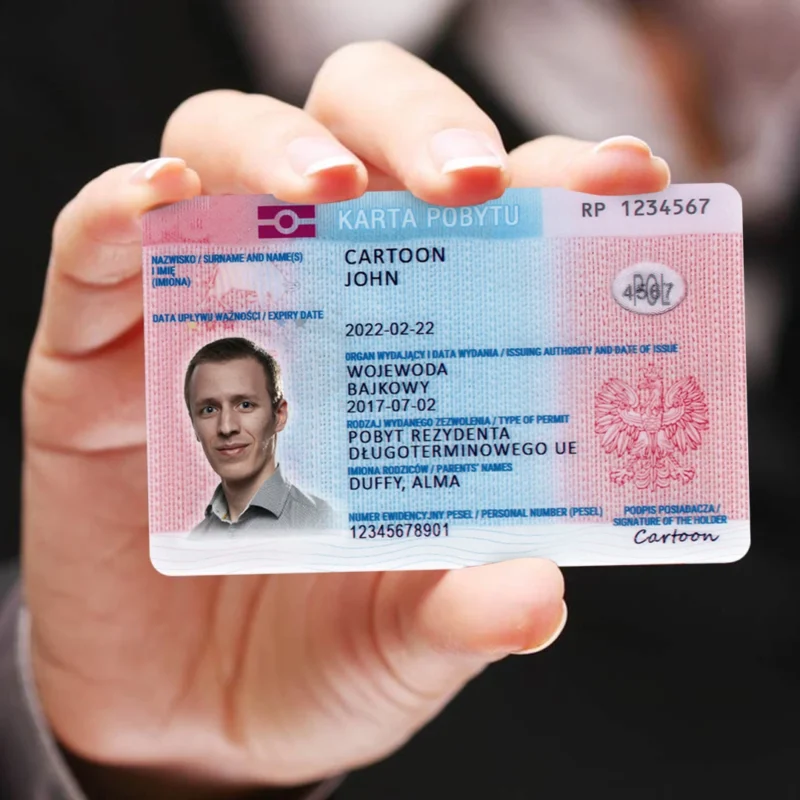
EU Long-Term Resident Permit in Poland
We assist with obtaining EU long-term resident status in Poland. We verify the 5-year period of legal residence, all absences and income for the required years.
Before submission, we determine whether the requirements for an EU long-term resident permit in Poland are met, which periods count in full or in part, and which documents must be prepared for electronic submission through MOS 2.0.
Who can apply for an EU long-term resident permit and when
Living in Poland for five calendar years alone is not enough. The authority checks the legal basis of each period, absences from Poland, income, health insurance, accommodation and proof of Polish-language proficiency.

5 years of legal residence
Immediately before applying, you must prove at least 5 years of legal and uninterrupted residence, taking into account the rules for counting individual grounds of stay.

Stable and regular income
For the standard category, income is verified for the 3 years immediately preceding the application and during the proceedings. For the statutory category of Blue Card holders, a 2-year period is verified.

Polish language at B1 level or above
You must provide one of the documents included in the exhaustive list of accepted evidence of Polish-language proficiency.

Health insurance
You must prove entitlement to public healthcare or insurance coverage for treatment costs in Poland.

Legal title to accommodation
You must provide a document confirming your right to use a specific dwelling, such as a tenancy agreement, ownership title or an admissible loan-for-use agreement.
Which periods count towards the 5-year requirement for an EU long-term resident permit
A calendar year may count in full, count by half or be excluded from the required period. The decisive factor is the legal basis of residence during the specific period.
Count in full
- Standard periods of legal residence, unless they fall under exceptions expressly provided by law.
- The period of proceedings for international protection, if the proceedings lasted more than 18 months.
- Statutory periods of residence of Blue Card holders, researchers and beneficiaries of international protection in other EU Member States.
Count by half
- Residence on a visa issued for higher education, doctoral-school studies or vocational training.
- Residence under a temporary permit for higher education or statutory vocational training.
- Half of the period of proceedings for international protection if the proceedings lasted no more than 18 months.
Do not count
- Residence in connection with temporary protection.
- Residence for the purpose of nauka, if legally it does not constitute higher education.
- Residence as a posted worker in the course of cross-border provision of services.
- ICT permits, long-term ICT mobility and certain short-term permits.
- The period after an obligation to return arose.
- Residence of members of diplomatic and consular missions.
- Proceedings for international protection that ended in refusal.
- Residence under a local border traffic permit.
UKR status and the CUKR card
The provision governing calculation of the five-year period uses the legal category of residence in connection with temporary protection, not the separate label PESEL UKR.
MOS's official position is that the period of temporary protection is not counted. The period under a CUKR temporary residence permit is counted from the date the CUKR card is granted.
This information reflects the administration's position. For mixed residence histories involving visas, extended documents, temporary residence cards and UKR status, the dates and legal grounds must be checked separately.
Open the MOS informationDOCUMENTS FOR AN EU LONG-TERM RESIDENT PERMIT VIA MOS 2.0
The basic list of documents depends on your residence history, source of income, insurance, absences from Poland and how you prove your knowledge of Polish.
What you usually need to prepare:
- An electronic application through MOS 2.0.
- Scan or photograph of all pages of a valid passport.
- A digital photograph for submission through MOS 2.0.
- Proof of payment of the PLN 640 stamp duty (opłata skarbowa).
- Copies of previous decisions on residence permits.
- Copies of previous residence cards, visas, stamps and other grounds for residence.
- Documents confirming legal residence in Poland for the required period.
- Documents concerning absences from Poland, if relevant to continuity of residence.
- PIT, UPO, contracts, proof of payments or other income documents.
- Documents confirming health insurance.
- A document confirming the right to reside at an address in Poland.
- A document confirming knowledge of Polish at least at B1 level.
- Sworn translations of documents if they were not issued in Polish.
- Access to Profil Zaufany, a qualified electronic signature or a personal signature.
- Electronically certified copies of paper originals - if this format is required in the case.
After the launch of MOS 2.0 paper supplements to an electronic case are not accepted at the service desk. If the authority requests additional documents, they must be prepared and submitted electronically through the official communication channel.
What income is required for an EU long-term resident permit
A stable and regular source of income is verified for the 3 years immediately preceding the application and during the proceedings. For the special category of Blue Card holders, a 2-year period is verified.
A person running a single-person household
Income must exceed PLN 1,010 net per month if the applicant runs a single-person household and has no dependants.
Per family member
Income must exceed PLN 823 net per month for each family member.
A person running a single-person household
The criterion applies when assessing income for the period from 1 January 2022 to 31 December 2024.
Per family member
The criterion applies to family income for the period from 1 January 2022 to 31 December 2024.
Income must exceed PLN 1,646 net per month.
Income must exceed PLN 2,469 net per month.
The assessment covers the amount of income, its regularity, actual receipt and the supporting documents for each required period.
Can a wife obtain an EU long-term resident permit without her own income
Yes. If the spouses are subject to the statutory community-property regime (ustawowa wspólność majątkowa) and have not established separation of property, the salary and other paid income earned by each spouse form part of their joint property.
Therefore, a wife who is not employed may use her husband's income to prove that the financial requirement is met. The case file should include the marriage certificate, evidence of a shared household, the spouse's PIT and UPO, contracts, income certificates, proof of payments and ZUS documents.
Registering the wife with ZUS as a family member confirms health-insurance coverage.
If the spouses have established separation of property (rozdzielność majątkowa), the financial situation must be assessed separately.
How to prove B1 Polish for an EU long-term resident permit
There is no separate Polish resident exam. To apply, you must prove Polish-language proficiency at B1 level or above with one of the documents on the exhaustive statutory list.
1. A state certificate of Polish as a foreign language at B1 level or above.
2. A European Consortium for the Certificate of Attainment in Modern Languages (ECL) certificate at B1 level or above.
3. A TELC certificate at B1 level or above.
4. A certificate from an eligible Polish university confirming completion of Polish-as-a-foreign-language classes or another permitted form of instruction.
5. A certificate granting the right to practise as a sworn translator or confirmation of entry in the official register of sworn translators.
6. A certificate of completion of a school in Poland where Polish was the language of instruction.
7. A diploma from a Polish university, if the programme was taught in Polish.
8. A certificate or diploma from a foreign educational institution where Polish was the language of instruction.
9. Applicants who are under 16 on the application date do not need a separate B1 document.
A certificate of completion of a post-secondary school (szkoła policealna) no longer proves Polish-language proficiency in a new case. The transitional rule applies only to proceedings initiated no later than 30 June 2026, provided the school was completed by 30 June 2025.
How much does an EU long-term resident permit application cost
The stamp duty and card-production fee must be paid before the application is submitted. Separate payment confirmations are attached to the MOS application.
Stamp duty
Payment for consideration of an application for an EU long-term resident permit.
Card production
Payment for production of the first plastic residence card. The confirmation is attached when the application is submitted through MOS.
Separate confirmations
PLN 640 and PLN 100 are paid separately. Two separate bank-transfer confirmations are uploaded to MOS.
Additional costs: if a representative acts in the case, a PLN 17 fee for the power of attorney may apply. Sworn translations, obtaining certificates and certified copies requested by the voivode are charged separately.
How to submit an EU long-term resident application through MOS 2.0
Since 27 April 2026, an application for EU long-term resident status must be submitted exclusively in electronic form through the new MOS portal. A paper application that did not reach the authority before that date will not be considered.
1. Create a new MOS account. Accounts from the previous version of the system are not transferred.
2. Log in personally through login.gov.pl.
3. Select the application for an EU long-term resident permit.
4. Complete all sections and check the residence dates.
5. Upload the digital photograph, all passport pages, the accommodation document and the remaining attachments.
6. Add separate payment confirmations for PLN 640 and PLN 100.
7. Sign and submit the application personally through login.gov.pl.
8. Save the UPO and application number.
9. After receiving a summons, attend the authority, present the original passport and a current document confirming the right to accommodation, provide fingerprints and a specimen signature.
10. Submit additional documents in the manner specified by the voivode.
What an EU long-term resident permit provides in Poland
The EU long-term resident permit is granted for an indefinite period. The plastic card is valid for 5 years, after which the document itself is replaced, not the status.
Indefinite right of residence
You do not need to obtain a new permit every few years or prove the previous ground of residence again.
Work without a separate permit
The status holder has unrestricted access to the Polish labour market, without the decision being tied to one employer.
No dependence on the previous ground of residence
Once the status is granted, you do not have to maintain a particular job, course of study or other previous ground for temporary residence.
Legalisation of family members
The status may be used as a basis for legalising the stay of a spouse and children. A separate application is submitted for each family member.
Short trips within the Schengen Area
A valid card together with a passport allows travel to other Schengen states under the 90/180 rule.
Further legalisation in another EU country
You may use the special procedure for long-term residents. The status does not grant an automatic right to move and work without a local permit.
Registering a JDG on the same terms as Polish citizens
With an EU long-term resident permit, you may register a JDG in CEIDG and conduct business in the same legal forms as Polish citizens. No separate business permit or special company form is required.
Legal basis: art. 4 ust. 2 pkt 1 lit. b ustawy o zasadach uczestnictwa przedsiębiorców zagranicznych i innych osób zagranicznych w obrocie gospodarczym na terytorium RP. JDG registrationWhat EU long-term resident status provides in practice
After obtaining EU long-term resident status, a person receives the most stable residence status available without citizenship. There is no need to renew the permit, repeatedly prove the basis of residence or remain tied to a particular life situation.
It also provides genuine mobility within the EU, simpler procedures when moving to another Member State and a stronger position for a future citizenship application. For people planning to live in Europe not just for a couple of years but seriously and long term, it is one of the key documents.
EU long-term resident permit
Ground
At least 5 years of legal and uninterrupted residence, taking special counting rules into account.
Income
Stable and regular income for 3 years, or for 2 years in the special Blue Card case.
Polish language
Proof at B1 level or above is required, except for applicants under 16.
Duration of the permit and card
The permit is indefinite. The plastic card is valid for 5 years.
Work in Poland
No separate work permit and no tie to a single employer.
Another EU country
A special legalisation procedure is available, but a permit from the chosen country is required.
Permanent residence
Ground
Karta Polaka, Polish origin, marriage to a Polish citizen, being the child of a Polish citizen and other cases provided by law.
Income
For most main grounds, there is no general requirement to prove income for three years.
Polish language
There is no general B1 requirement for permanent residence.
Duration of the permit and card
The permit is indefinite. The plastic card is valid for 10 years.
Work in Poland
No separate work permit.
Another EU country
This is a national Polish permit and does not in itself create EU long-term resident status.
Neither status is automatically better than the other. The right choice depends on the available legal ground, residence history and future plans.
Assistance with obtaining an EU long-term resident permit in Warsaw
We provide support with obtaining an EU long-term resident permit in Warsaw, from the initial assessment to the decision. Our focus is to ensure that the inspector at the Mazowieckiego Urzędu Wojewódzkiego immediately receives a clear picture of the residence period, income, insurance, accommodation and language documents.
We handle first-time and repeat applications, as well as cases with disputed periods in the residence history that affect the five-year period: changes of legal ground, periods of study, gaps in legal stay, lengthy absences, changes in the source of income or form of employment. In such cases, we build the evidence in advance and organise the documents into a consistent structure.
We conduct a consultation, assess whether your residence history qualifies for EU long-term resident status and set out an action plan.
We prepare a personalised checklist based on your situation and periods of residence.
We verify the residence period and legal grounds year by year, identify risks and specify which documents are needed to address them.
We organise evidence of income, insurance and accommodation so that the dates and legal grounds are consistent.
We prepare the application and attachments for submission in Warsaw, put the documents into a consistent format and arrange translations where necessary.
We support the proceedings: we prepare responses to wezwania and submit the requested documents.
If the proceedings are delayed, we prepare a ponaglenie and handle the subsequent steps in the administrative procedure.
After the decision, we support the final stage of collecting the plastic residence card.
If the decision is negative, we prepare an appeal and legal arguments addressing the reason for refusal.
A child may obtain permanent residence after a parent is granted resident status
A minor child of a foreign national may apply for permanent residence if the parent has obtained permanent residence or EU long-term resident status, the child is under that parent's parental authority and the statutory requirements relating to the child's date of birth are met.
This ground applies if the child is under the parental authority of a foreign national who has obtained permanent residence or EU long-term resident status in Poland.
The child must:
- 1have been born after the parent obtained such a permit;
- 2or have been born while the parent's temporary residence permit was valid;
- 3or have been born while the parent was residing on another ground expressly provided by law.
The status is not granted automatically. A separate application must be submitted for the child.
Time limits in residence-card proceedings are suspended until 4 March 2027
The statutory time limit for an EU long-term resident case is 6 months after the statutory conditions for the time limit to begin running have been met. At the same time, art. 100d suspends the running of time limits in cases handled by voivodes.
Cases continue to be processed. The voivode may request documents, conduct checks and issue a decision before the suspension period ends.
Until 4 March 2027, a delay does not produce the standard legal consequences of administrative inactivity. Therefore, a ponaglenie and a complaint to the WSA should not be marketed as a guaranteed way to accelerate a decision or obtain financial compensation.
When can you approximately expect a decision on an EU long-term resident permit
Enter the application date. The calculator will show the statutory reference date and separately warn that the running of time limits is suspended until 4 March 2027.
When can you approximately expect a decision?
Enter the filing date or planned filing date and select the case type. We will show the difference between the statutory time limit and the approximate practice in Warsaw.
You may enter a future date when you are only planning to file.
Your processing-time estimate
Comparison of the statutory time limit and the approximate practical waiting time in Warsaw.
Filing date
The date from which the estimate is calculated.
Statutory time limit
—
Practice in Warsaw
Approximate practical waiting time.
This is an estimate, not an official forecast
The actual processing time depends on the voivodeship, the legal basis, requests for additional documents, the completeness of the file and the workload of the voivodeship office.
Proceedings may not be initiated
For example, if on the application date the applicant is staying on a ground that excludes this procedure, or the application was not submitted in the mandatory electronic form.
The permit may be refused
If the five-year period, continuity of residence, income, health insurance, accommodation, Polish-language proficiency or another mandatory condition is not proven.
14 days to appeal
The appeal is addressed to the Head of the Office for Foreigners and submitted through the voivode who issued the negative decision.
The appeal is not submitted through MOS.The status may be withdrawn
This may happen, in particular, if the status was obtained unlawfully, the person has been absent from Poland for more than 6 years, has remained outside the EU for too long, or has obtained long-term resident status in another EU country.
A refusal cannot be remedied with a template letter. Before preparing an appeal, the decision, the evidence in the case file and the voivode's legal assessment must be analysed together.
How to start working with us?
We analyse every case individually and select a solution tailored to your situation.
-
01
01
Submit an enquiry
Complete the form and we will contact you shortly.
-
02
02
Receive a consultation
The initial telephone consultation is free.
-
03
03
Arrange an office appointment
At the office, we will analyse your situation in detail and recommend the best solution.
-
04
04
Document submission
The application is submitted online through MOS 2.0. We provide full support throughout the process.
-
05
05
Receive the result
We cannot guarantee the outcome, but we will do everything possible to achieve a positive result.
Positive residence-card decisions
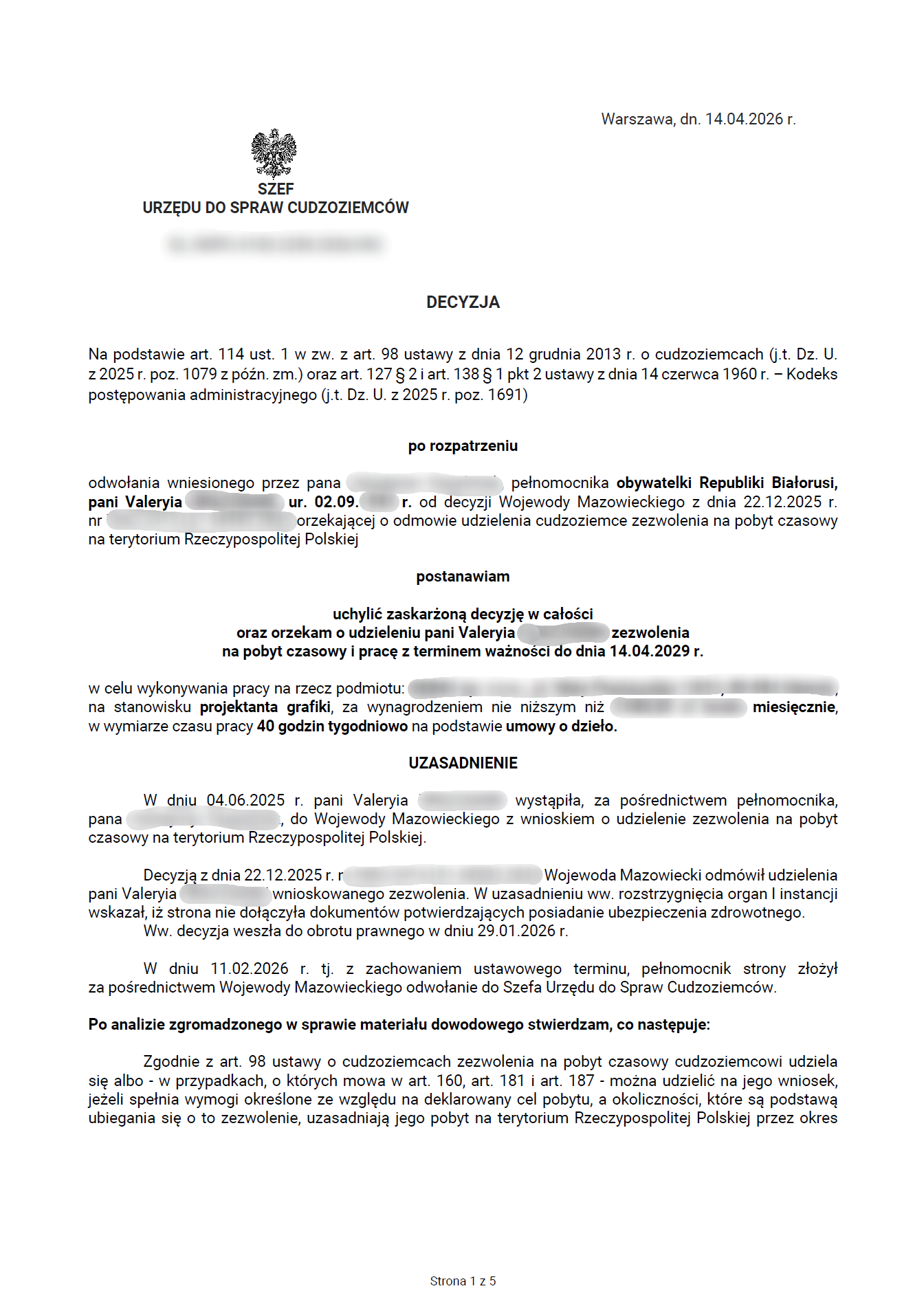
Positive decision after a refusal.
Residence card for 3 years
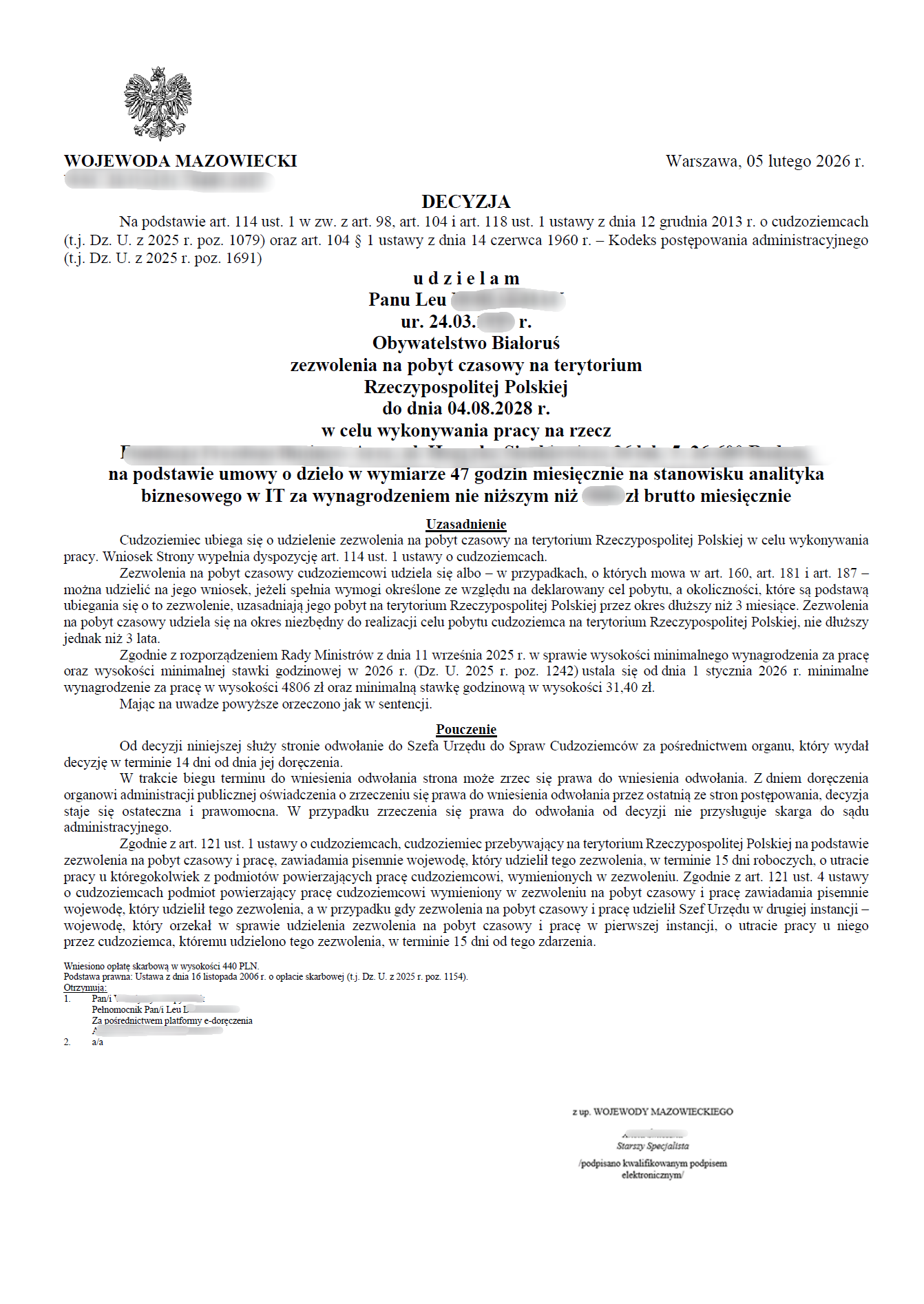
Positive decision on a residence card based on employment
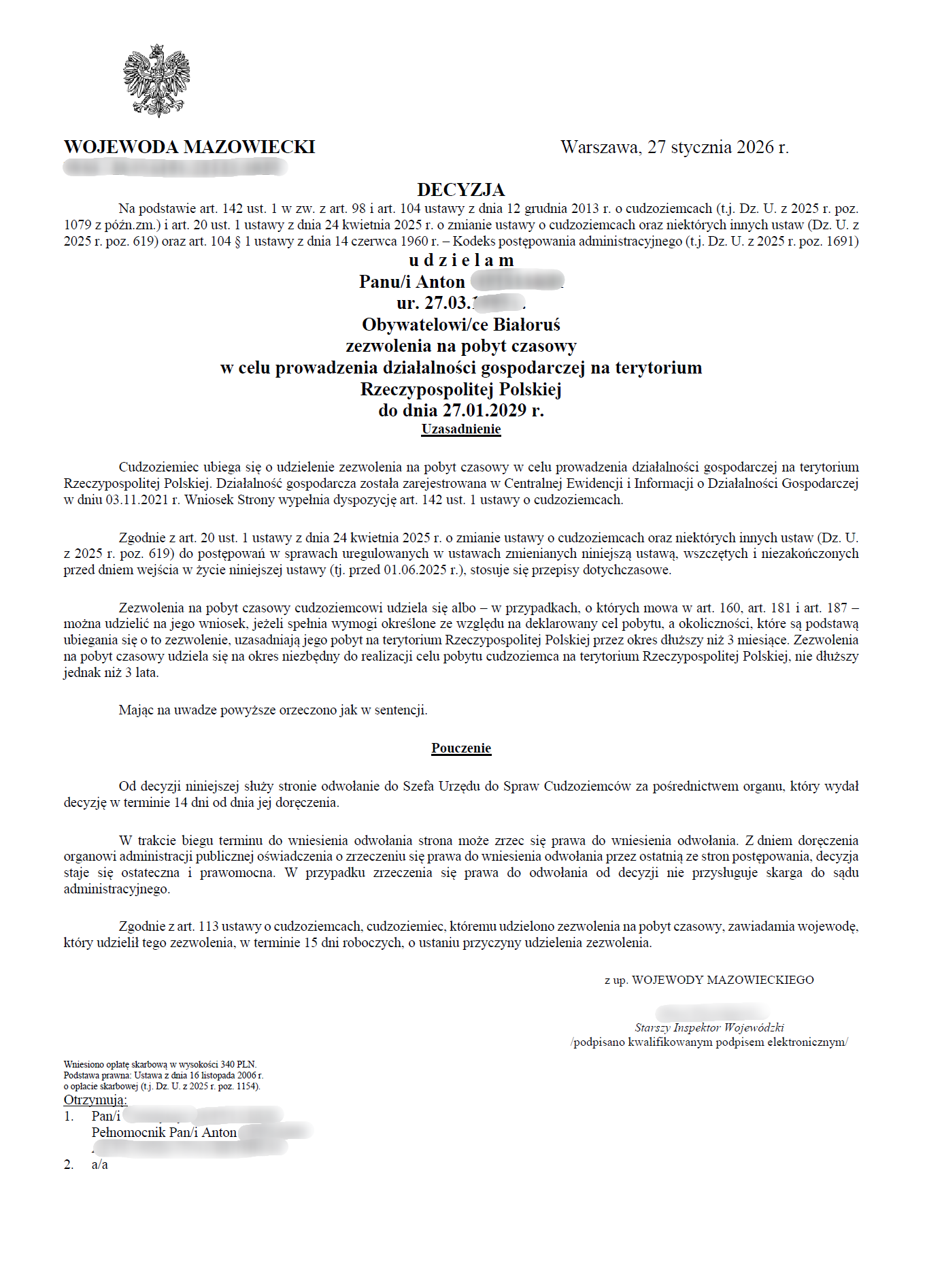
Positive decision on a residence card based on business activity
Telegram bot SKILLDOCS
Every client receives free access to our bot, which makes the legalization process in Poland easier and more transparent.
Automatic INPOL case monitoring
The bot monitors changes in the case and notifies the client as soon as a new status or decision appears.
Case status and stages in one chat
The client can see the current stage of the case and which actions are being handled by our team.
Appointment and deadline reminders
Notifications help you avoid missing an appointment at the immigration office or an important document deadline.
Active tasks in your case
The bot shows what is currently in progress and which steps are still ahead.
Send a task to our team through Telegram
The client can quickly send a task to our team without unnecessary calls or waiting.
cases connected to the bot
The bot checks case statuses every day and immediately notifies clients about new updates and decisions.
Current INPOL case status
Full name: Ruslan
Case number: WSC-II-P..2026
Case status: W toku - wezwanie o braki merytoryczne
Active case: Przygotowany projekt decyzji pozytywnej
Latest event:
Decision deadline: .2026
16:10SKILLDOCS combines professional support
with automated post-submission case monitoring.
Frequently asked questions
A foreign national's residence in Poland is considered uninterrupted if:
- No single interruption exceeded six months;
- All interruptions during the five-year period did not exceed 10 months in total.
You may leave Poland, but you need a visa or another legal basis to re-enter.
An EU long-term resident permit is granted for an indefinite period, but the card itself must be replaced every 5 years.
You must prove the required period of legal and uninterrupted residence, stable income, health insurance, a legal title to accommodation and Polish-language proficiency at B1 level or above. The application is submitted electronically through MOS.
The main package includes an electronic application, a digital photograph, all passport pages, a document concerning accommodation, payment confirmations, and documents concerning residence, absences, income, insurance and Polish-language proficiency.
The permit itself is indefinite. The plastic card is valid for 5 years, after which a new card is issued without the status being granted again.
Yes, if the spouses are subject to community property and the other spouse's income is used to maintain the shared household. The income must be evidenced by PIT, UPO, contracts, certificates and proof of payments.
Higher education, doctoral-school studies and statutory vocational training count by half. Residence for the purpose of nauka may not count.
Under the standard rule, no single absence may exceed 6 months and all absences during the five-year period may not exceed 10 months in total, unless a statutory exception applies.
Contact Information and Office Addresses
Contact us in any convenient way or visit one of our offices. We are always ready to answer your questions.
If you have any questions or suggestions, please contact us via the website form, messengers, or email. We will respond promptly.
+48 570 804 478
contact@skilldocs.pl
Wincentego Rzymowskiego 30, Lokal 323 02-697 Warszawa
If you have any questions or suggestions, please contact us via the website form, messengers, or email. We will respond promptly.
+48 537 097 502
contact@skilldocs.pl
Marszałka Józefa Piłsudskiego 74, 50-020 Wrocław
By submitting the form, you accept the Privacy Policy and consent to being contacted.
If you have any questions or suggestions, please contact us via the website form, messengers, or email. We will respond promptly.
+48 536 535 645
contact@skilldocs.pl
Ul. Szkolna 1/308, 61-832 Poznań
By submitting the form, you accept the Privacy Policy and consent to being contacted.


