

UKR and EU long-term residence: UdSC recommends excluding years under temporary protection


UdSC recommends excluding years spent in Poland solely under temporary protection, including UKR status, from the five-year period required for EU long-term resident status. In the Office’s view, switching to an ordinary temporary residence permit or obtaining CUKR does not change how earlier years under UKR are assessed. [1]
On 26 October 2026, we received the full text of the letter from the Head of the Office for Foreigners and an official reply confirming that it had been circulated to the voivodeship offices. Below, we publish the documents, examine UdSC’s legal reasoning and explain what to consider when applying, lodging an administrative appeal or bringing a case before a court. [2]
📅 UPDATE — 26.10.2026: official reply received from UdSC
This is not a new law introduced on 26 October. The recommendation appears in the letter of 23 January 2026, reference DPM.07037.89.2025. The reply of 26 October 2026, reference DPM.069.25.2026, confirms that the letter was sent and provides its full text.
Which documents SKILLDOCS received
In response to a public information request dated 15 October 2026, UdSC supplied the January letter from the Head of the Office and a record relating to its dispatch via ePUAP. The covering reply expressly states that the letter was circulated electronically and copied to the relevant department of the Ministry of the Interior and Administration (MSWiA) and the Foreigners’ Affairs Directorate of the Border Guard Headquarters.
The main letter is addressed to all directors of the departments responsible for foreigners’ affairs at the voivodeship offices. It is therefore not an individual reply from one office to one applicant, but a position intended for application by the voivodeship authorities.

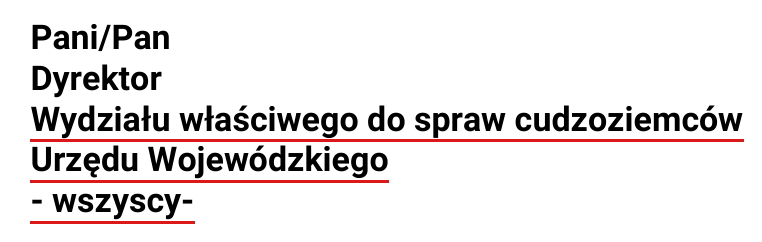
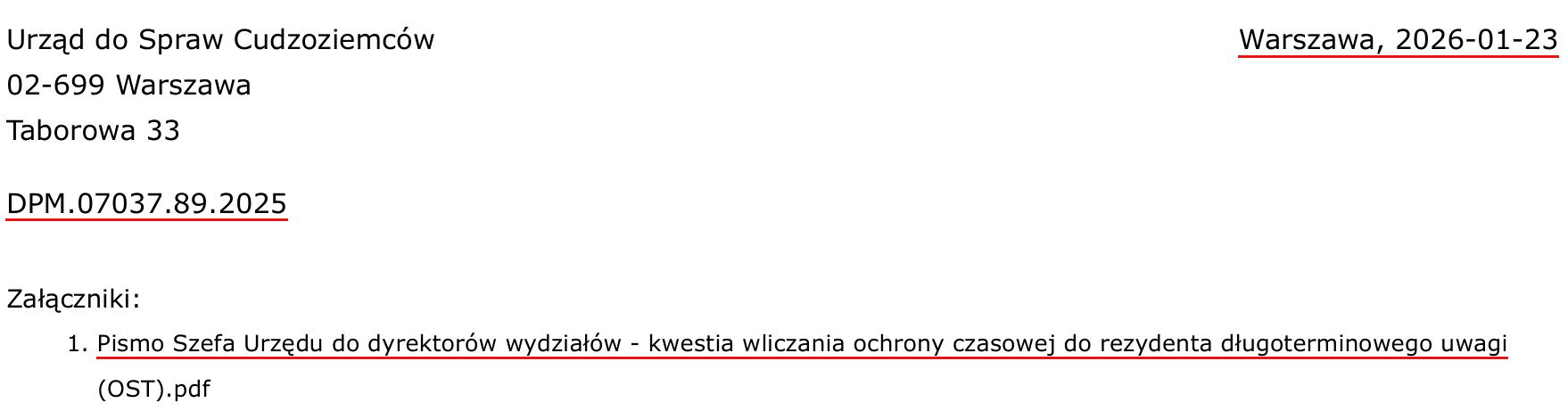
A document reference ending in “2025” does not mean that the letter is dated 2025: the date shown on the letter itself is 23.01.2026. The full six-page text and the reply confirming circulation are available at the end of this article. The recipient’s personal data have been removed from the publication copy of the reply; the legal position and the Office’s details have been preserved. [1] [2]
Which periods UdSC recommends excluding
The letter’s main conclusion concerns residence in Poland under temporary protection — both under the Act on Granting Protection to Foreigners and under the special provisions for Ukrainian citizens.
UdSC also considers the situation of a person who has already ceased to benefit from temporary protection: they have obtained another residence permit and are applying for EU long-term resident status. In the Office’s view, the new basis does not turn earlier UKR periods into qualifying periods.
The relevant issue is not nationality or simply having obtained a PESEL number, but the legal basis for each period of residence. The letter does not prohibit all Ukrainian citizens from obtaining EU long-term resident status, nor does it declare all their years after 2022 “non-qualifying”. Any period spent on another basis must be assessed separately. [1]
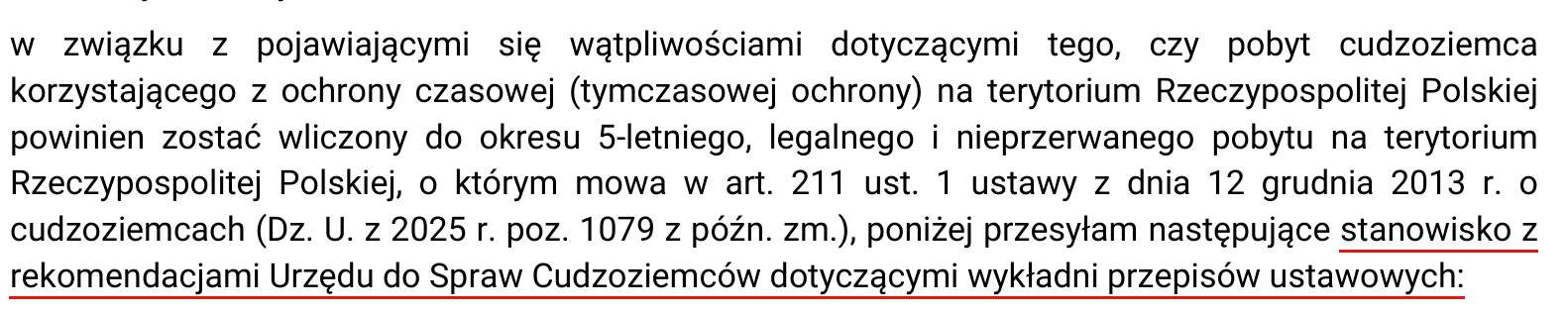
What UdSC and the voivodeship office have published
Question 57 of UdSC’s official CUKR FAQ states that the period under CUKR counts from the date the card is collected, while preceding residence under UKR status is not included. This public explanation is consistent with the conclusion of the January letter. [5]
Question 10 of the Lublin Voivodeship Office’s UKR FAQ also states that UKR is not counted, referring to the position of the Head of UdSC. The question specifically concerns a person who worked and paid contributions throughout that time. The answer does not create an employment exception: working and paying ZUS contributions do not, by themselves, change the legal basis of residence. [6]
A common recommendation helps assess the risk of an administrative refusal. It does not establish that an identical decision has already been issued in every individual case in every voivodeship.
What the law says and where the legal dispute arises
This issue requires a distinction between the conditions for obtaining resident status, the rules for counting years and the admissibility of an application. These are separate provisions:
– Article 211(1) of the Act on Foreigners requires at least five years of lawful and continuous residence immediately before the application and sets out other conditions for the permit.
– Article 212 governs qualifying periods, exclusions and continuity. The list in Article 212(2) contains no separate express reference to a past period of temporary protection as such.
– Article 213(1)(1)(e) provides for refusal to initiate proceedings where, on the application date, the person is staying in Poland in connection with temporary protection granted to them. [3]
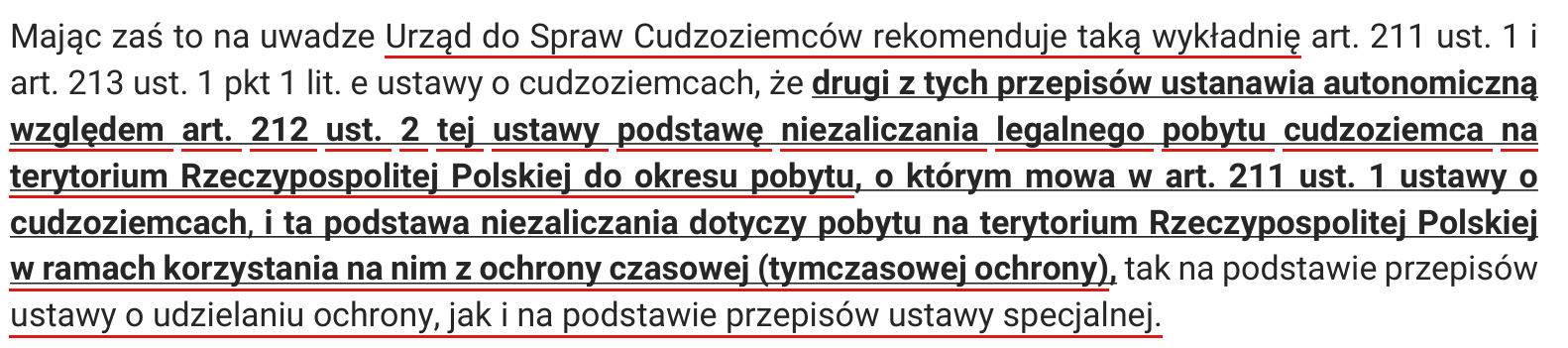
UdSC’s position goes beyond the literal rule concerning the applicant’s current basis of residence. The Office proposes reading Article 211 together with Article 213 so that the latter supplies an independent basis, separate from the list in Article 212(2), for excluding past residence under temporary protection as well. This explanation — not a new item added to Article 212 — is what the letter contains. [1]
Which EU provisions UdSC relies on
The letter compares Article 3(2)(b) and Article 4 of Directive 2003/109/EC. The first provision excludes from the Directive’s scope people who benefit from temporary protection or are awaiting a decision on an application on that basis. However, the rules on counting previous periods in Article 4(2) contain no equivalent express reference to that point. [1] [4]
UdSC expressly acknowledges that a literal interpretation of these provisions does not produce an unambiguous result. The Office then adopts a purposive interpretation, arguing for exclusion because temporary protection has, from the outset, a different character from residence offering a prospect of lasting settlement.
The letter cites judgments of the Court of Justice of the EU on the nature of temporary residence and temporary protection. Citing those judgments does not mean that a court has specifically ruled on counting years under UKR in Poland after a switch to another permit.

Does the absence of an express exclusion in Article 212 mean that UKR must be counted?
No, that conclusion does not follow automatically. The absence of an express exclusion is an argument for a legal challenge, but the authority counters it with its own systematic and purposive interpretation. An individual case requires examination of both approaches, the applicable version of the legislation and the applicant’s residence history.
This letter is not an amendment to the law and does not replace judicial review of an individual decision. At the same time, the official position of the authority that hears appeals cannot be ignored. Legal grounds for a challenge and a guaranteed favourable outcome are not the same thing.
Applying for EU long-term resident status while on UKR: a separate obstacle
If, on the application date, the person is still staying specifically on the basis of temporary protection, Article 213(1)(1)(e) applies. This concerns refusal to initiate proceedings, not merely a dispute over how many years should count.
The position after switching to an ordinary permit or CUKR is different: the obstacle arising from current temporary protection must be distinguished from the assessment of a past UKR period. Removing the first obstacle does not, by itself, resolve the second issue. [1] [3]

Which periods under CUKR and ordinary residence permits count
CUKR: the period starts when the card is collected
According to UdSC’s official FAQ, the qualifying CUKR period starts on the day the card is collected. It does not start when the application is sent, the fee is paid or production of the document begins. Obtaining CUKR does not automatically allow earlier years under UKR to be included. [5]
An ordinary temporary residence permit
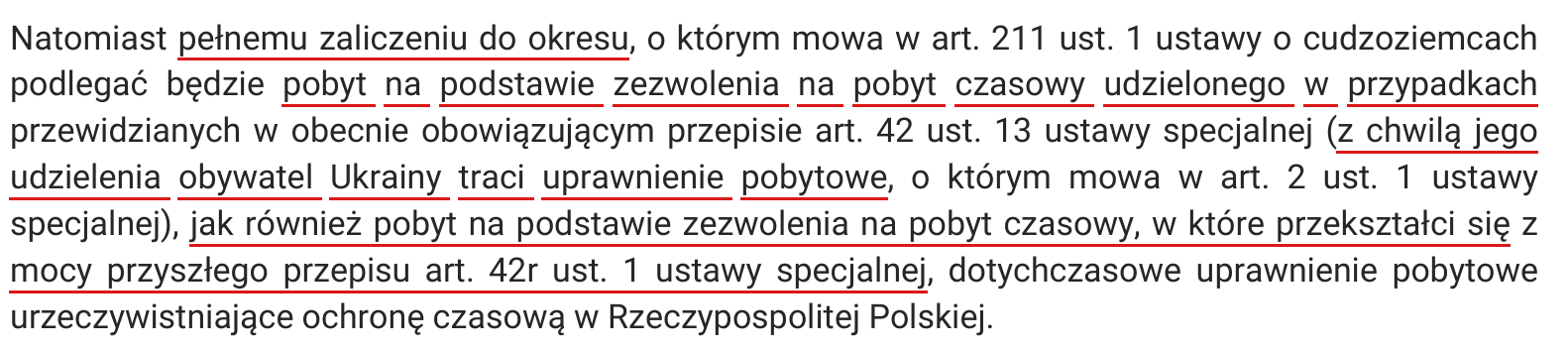
In its January letter, UdSC separately confirms full recognition of residence under permits granted in the situations then covered by Article 42(13) of the special act, as well as the future conversion of status into CUKR. For an ordinary permit, the legal basis arises in connection with its grant; the date the plastic card is collected is no substitute for examining the decision and the permit’s period of validity. [1]
This does not mean that “every temporary residence card counts at 100%”. Study-related grounds and other special categories must be checked separately under Article 212. The specific legal provision under which the permit was granted matters, not the appearance of the card. [3]
Example: three years under UKR and two years under a work-based permit
Assumptions: a person spent three years solely under temporary protection, followed by two years under a temporary residence and work permit that counts in full. There are no other qualifying periods, and continuity has not been broken.
Under UdSC’s approach: 3 years under UKR × 0 + 2 years under a work-based permit × 1 = 2 qualifying years of residence, not 5. This illustrates the Office’s position; it is not an individual ruling on a particular applicant.
If the CUKR card was collected on, for example, 1 August 2026, the relevant period starts on that date. Previous years under UKR do not retrospectively become years under CUKR. Any further calculation must account for a continuing lawful basis of residence, travel and the other requirements for resident status.
Why a refusal is possible both at the voivode’s office and on appeal
At first instance, an EU long-term residence permit is granted or refused by the voivode competent for the applicant’s place of stay — Article 218. Administrative appeals and interlocutory appeals against procedural orders fall within the remit of the Head of UdSC — Article 22 of the Act on Foreigners. [3]
Moving to the second instance therefore does not mean that the issue will be considered by an authority unrelated to UdSC’s published position. This is a reason to take the risk of a further refusal into account, not to claim in advance that every appeal will be rejected.
The document received must first be classified correctly:
| Act received | Available remedy | General time limit |
|---|---|---|
| Decision refusing EU long-term resident status — decyzja | Administrative appeal (odwołanie) to the Head of UdSC through the voivode who issued the decision | 14 days from service: Article 129 of the Code of Administrative Procedure (KPA) |
| Order refusing to initiate proceedings — postanowienie o odmowie wszczęcia | Interlocutory appeal (zażalenie) under the applicable procedure | 7 days from service: Article 61a § 2 and Article 141 § 2 KPA |
| Final administrative refusal following the second instance | Complaint to the Voivodeship Administrative Court (WSA), filed through the authority whose act is challenged | 30 days from service: Article 53 § 1 and Article 54 § 1 of the Law on Proceedings before Administrative Courts (p.p.s.a.) |
These are different procedural time limits. Do not apply the deadline for appealing a decision to an order refusing to initiate proceedings. Check the instructions on appeal rights (pouczenie), the date of valid service and the rules for calculating the time limit. [7] [8]
Does residence remain lawful during an appeal?
Administrative appeal
If the application for resident status was lodged during lawful residence and has no formal defects, or those defects were remedied on time, the law provides for residence to remain lawful until the final administrative decision. For new cases under the electronic procedure, the relevant provision is Article 222a(1); earlier cases require consideration of the transitional provisions and the rules governing the relevant procedure. [3] [9]
An admissible appeal lodged on time prevents the first-instance decision from becoming final before the appeal is determined. However, the word “appeal” does not cure an initially unlawful stay, a late application or unremedied formal defects. A separate exception concerns proceedings suspended at the applicant’s request. [3] [7]
Complaint to the WSA
Filing a complaint with an administrative court does not, by itself, extend lawful residence. A judicial complaint is not another administrative appeal, and Article 61 § 1 p.p.s.a. does not provide for an automatic stay of enforcement of the challenged act. The availability and effects of interim relief require separate assessment; it cannot be treated in advance as a new residence permit. [8]
Going to court requires two separate checks: whether there are grounds to challenge the decision and on what basis the person will remain in Poland while the dispute is pending. Confirmation that the court has accepted the complaint does not replace the second check.
What the 30 days after a final refusal mean
In the situations covered by Article 299(6)(1)(a), an obligation arises to leave Poland within 30 days. Where the refusal is issued by the second-instance authority, the time limit runs by reference to service of that decision. It must not be confused with the separate 30-day deadline for bringing a complaint before the WSA.
The exceptions must be considered: Article 299(8) preserves the relevance of another valid basis of lawful residence; paragraph 7 includes a condition concerning timely submission of the original application; paragraph 8a sets out a special procedure where return proceedings have already been initiated or a return decision has been issued. It is therefore incorrect to say that “every refusal automatically gives everyone 30 lawful days”. [3]
Can a temporary residence application be submitted in parallel?
A separate application for temporary residence may be considered alongside an EU long-term residence case if it is admissible for the individual concerned. A pending application for resident status is not the same as already holding that status. The second case must nevertheless have its own genuine purpose and meet the statutory requirements.
Before filing, check the current basis of residence, the restrictions in Article 99, the documents for the chosen purpose and compliance with Article 108 for lawful residence during the proceedings. Special restrictions and exceptions apply while temporary protection remains in force. This is not a universal instruction for a UKR holder to submit any two applications at the same time. [3]
It is particularly risky to wait for a final refusal and then rely on a new application during the period allowed for departure. Article 99(1)(9) provides for refusal to initiate temporary residence proceedings where the person is required to leave under Article 299(6). The possibility of an independent basis must be assessed before that obstacle arises, not afterwards.
Nor is a second application an unconditional safeguard: it may also end in refusal or encounter a procedural obstacle. Lawful residence should not automatically be equated with permission to work on any terms.
What to check before applying or disputing the treatment of UKR years
– Residence history: the exact periods under UKR, other permits, visas and CUKR. Documents and dates are needed, not just the total years since the first entry.
– The current basis on the application date: whether temporary protection has ended and whether there are any obstacles to opening the EU long-term residence case.
– Two calculations: one excluding the disputed UKR periods and one including them, if you intend to argue that they should count. Understand the difference before choosing a strategy.
– The other requirements for resident status: continuity, income, insurance and proof of Polish-language proficiency. A dispute over UKR does not remove the remaining requirements.
– Procedural dates: filing, remedying defects, service of decisions and the deadlines for challenging them.
– The basis for continued residence: what will remain valid in the event of a final refusal and court proceedings.
Practical conclusion: you cannot currently rely on all UKR years being counted automatically. When planning the administrative process, take UdSC’s published position into account. For a challenge, prepare specific legal arguments and separately maintain a lawful basis of residence.
Assistance with EU long-term resident status and further residence procedures
At SKILLDOCS, we will review your documents and residence history, distinguish undisputed from disputed periods and explain which issues need to be resolved before filing. Details of our support are available on the page about obtaining EU long-term resident status.
If another basis of residence is needed, our available services are listed in the residence cards and lawful residence in Poland section. We first examine the person’s circumstances and then choose the procedure. A positive decision or success in court is not guaranteed.
Need to check your UKR years and eligibility to apply for EU long-term resident status?
Official sources
This legal analysis was prepared on 27 October 2026. The January letter and October reply are published as UdSC documents; conclusions about the risks of applying and challenging a decision are presented separately from the letters’ contents. Red underlining in the extracts is editorial emphasis, not an alteration to the original. The publication copy of the reply, with the recipient’s details removed, is not intended for electronic signature verification.
3. Act on Foreigners: Articles 22, 99, 108, 211–214, 218, 222a and 299 ↗
4. Directive 2003/109/EC: Articles 3 and 4 — scope and the five-year period ↗
5. UdSC: CUKR — questions 57–58 on qualifying residence and the card collection date ↗
6. Lublin Voivodeship Office: UKR FAQ, question 10 on the five-year period ↗
7. Code of Administrative Procedure: Articles 61a, 129–130 and 141 ↗
8. Law on Proceedings before Administrative Courts: Articles 53, 54 and 61 ↗


